
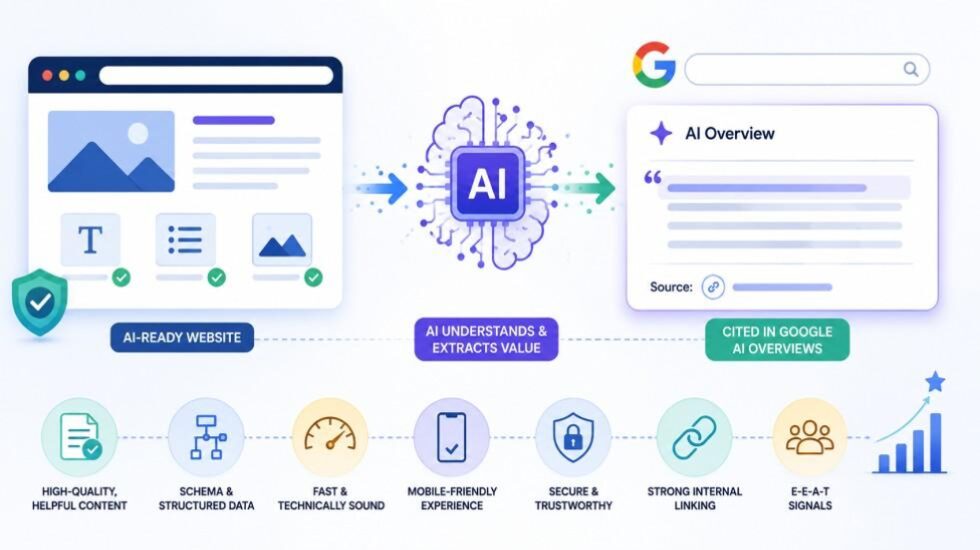
Try this right now: search for almost anything on Google. Odds are, before you scroll past the first inch of the page, there’s already a box answering your question. Google calls it an AI Overview. Most people read it, get their answer, and never check where it came from. If you run a website, that should give you pause.
A few things worth sitting with before we get into the mechanics:
- Ranking on page one isn’t the finish line anymore, it’s closer to the midpoint.
- AI Overviews stitch together pieces from multiple pages into a single answer.
- You can hold position three for your keyword and still watch traffic go flat, because the searcher already got their answer without clicking anywhere.
- The old question was “how do I rank higher.” The one that matters now is “how do I get picked as the source.”
- GEO Generative Engine Optimisation grew out of exactly this shift, and it now sits alongside traditional SEO services rather than replacing them.
Google has actually written about this directly, so it’s worth reading their version instead of five blog posts paraphrasing it. Google’s own guidance on optimising for generative AI features is straightforward: there’s no hidden markup or secret switch. Sites that get cited are usually just handling the basics well. The rest of this post is really an attempt to spell out what “handling the basics well” looks like once AI Overviews are part of the picture.
Why Do AI Overviews Don’t Play by the Old Rules?
Classic rankings still lean on the familiar list relevance, backlinks, page speed. AI Overviews want something else, and it’s harder to fake: clarity. Whatever system is stitching the summary together needs a clean answer it can lift as-is, not three paragraphs of setup before the actual point shows up. Pages padded to hit a word count, or written the long way round just to look thorough, quietly get left out even ones ranking perfectly well in normal search.
A lot of businesses are still working off the old playbook. Keyword stuffing. Thin pages built around ad slots. Listicles that don’t get to the answer until paragraph nine. Then they’re stuck wondering why a competitor with a noticeably weaker backlink profile is the one showing up in the AI box. Nine times out of ten it’s not complicated that competitor just answered the question up front, backed it with something specific, and didn’t make anyone dig for it.
Neil Patel’s team has looked into this more closely than most, and it’s worth reading if you want the actual mechanics rather than the shorthand version. Neil Patel’s write-up on how AI Overviews work gets into why certain pages get pulled into overviews while similar ones get passed over, based on data his team has been tracking since AI Overviews launched.
Structure Content the Way a Machine Actually Reads It:
People skim. Machines parse. Good writing serves both, but content aimed at AI citation needs to lean harder into structure than most of us are used to.
Write headings the way someone would actually type them into Google. “Our Approach” tells nobody anything. “How Long Does Local SEO Take to Show Results” tells the reader and the machine exactly what’s coming. Answer it in the first sentence or two, then go into detail underneath. This answer-first habit works because AI systems tend to lift whatever chunk of a page is most self-contained and easiest to quote on its own.
Short lists help for the same reason not because they look neat, but because a model can pull them out cleanly without untangling a dense paragraph first.
Worth building into your process:
- Write H2s and H3s the way someone would search, not the way a brand deck would phrase them
- Answer first under each heading, explain after
- Keep paragraphs to three or four sentences
- Use a comparison table where it genuinely fits these get pulled into summaries often
- Add schema (FAQ, HowTo, Article) so context is explicit rather than implied
Originality Still Matters Maybe More Than Before:
There’s a pattern in pages that get cited: something in there is genuinely original. A stat nobody else is quoting. An opinion with a bit of edge. An example that isn’t a rehash of what’s already ranking. If your page is just a reshuffled version of the top ten results, there’s no reason for an AI model to pick yours over anyone else saying the same thing.
This is usually where the gap shows between generic content mills and a team actually doing ai seo services properly. It’s not about publishing more, it’s about each page saying something nobody else has said quite that way. A case study from your own client work. A number nobody bothered to quote. A take that pushes back, even slightly, on the accepted wisdom. Small things, but they tend to be what separates a page that gets cited from one that gets skimmed and forgotten.
Don’t Skip the Technical Groundwork:
None of the writing advice above counts for much if the site behind it is a mess. Crawlability, load speed, mobile experience, sensible internal linking, all of this mattered for classic search already, and it matters more now, since AI crawlers often work with tighter resource budgets than a standard Googlebot pass.
Worth checking regularly:
- robots.txt isn’t accidentally blocking crawlers you actually want indexing your pages
- Page speed is genuinely fast not “fast on a good day.” Slow pages get abandoned mid-crawl more often than people assume
- Semantic HTML is doing the work, not JavaScript rendering a crawler might not fully execute
- Your XML sitemap is current and has actually been resubmitted through Search Console recently
- Broken links and redirect chains are cleaned up, since these interrupt a crawler mid-pass
None of this is new advice. What’s changed is the cost of ignoring it. A technically messy site used to just lose some ranking. Now it risks not being seen by the systems generating AI answers at all.
E-E-A-T Carries More Weight Than It Used To:
Experience, Expertise, Authoritativeness, Trustworthiness Google’s long-running quality framework has picked up fresh relevance in the AI Overview era. Generative systems seem to weigh author credibility and site reputation fairly heavily when deciding what to trust for a summary, especially on anything touching money, health, or legal advice.
In practical terms, author bios are worth writing properly again not tacked on as an afterthought. Real credentials help. Genuine reviews, honest client testimonials, mentions from other reputable sites all of it builds a trust signal that’s slow to earn and hard to fake convincingly. A site with a handful of well-earned mentions across relevant publications will often beat a site with ten times the content and none of that backing.
Moz’s original SEO guide still explains why these signals matter better than most newer content on the topic. Moz’s Beginner’s Guide to SEO covers authority-building and technical fundamentals in a way that’s held up surprisingly well, even with an entire AI layer sitting on top of it now.
Side by side, the shift looks roughly like this:
| Factor | Traditional SEO Focus | AI-Ready (GEO) Focus |
| Content goal | Rank high on the results page | Get selected as the cited answer |
| Structure | Keyword-led headings | Question-led, answer-first headings |
| Ideal length | Longer was often assumed better | As long as it needs to be, no padding |
| Originality | Rewriting what’s already ranking | Genuinely unique data or opinions |
| Trust signals | Backlinks, domain authority | E-E-A-T, author credibility, mentions |
| Technical priority | Speed and crawlability | Speed, crawlability, clean semantic HTML |
What Does This Means for Businesses Planning Their Next Move?
Most businesses figuring out where to put their budget would do well to treat GEO and traditional seo services as two halves of one strategy, not competing line items. Classic search rankings still bring in real traffic that hasn’t changed. Getting cited inside an AI Overview builds a different kind of presence, one that puts your brand in front of someone even on the occasions they never click through.
You can already see this in how the better agencies are rebuilding their content calendars: more answer-first formatting, tighter use of structured data, and a lot less patience for the keyword-density thinking that was standard practice two or three years back. Ask around and most of the best digital marketing agencies in India will tell you the same thing: originality isn’t a nice-to-have anymore. It’s the whole game.
This isn’t limited to the big-city names either. Some of the sharper work is quietly coming out of smaller hubs, where businesses are adapting quickly to changing web design trends. A digital marketing agency in Ahmedabad juggling e-commerce accounts alongside local service clients ends up solving for AI visibility and plain old conversion-focused SEO in the same breath, week after week. That kind of pressure tends to produce frameworks that actually hold up in practice, not the theory-heavy playbooks recycled everywhere online.
Final Thoughts
Getting cited inside Google AI Overviews doesn’t come from a trick bolted onto content you’d already written anyway. It comes from writing with more precision, structuring pages so a machine can actually parse them, backing claims with something original, and not skipping the technical groundwork that makes crawling possible in the first place. The sites winning this kind of visibility usually aren’t the ones with the biggest content libraries.
They’re just the ones that made themselves easy to trust and easy to quote which, broken down, is a fairly reachable bar for most businesses willing to drop a few habits that stopped working a while back.
